How you go from zero instructional design experience to your first ID job, one reviewed portfolio sample at a time.
The Applied ID Portfolio Method is a five-stage method developed by Jill Davidian of Learning Strategy & Design. It takes career changers from zero instructional design experience to their first ID job through scaffolded skill-building, iterative expert reviews and the LEAD AI Framework for working with AI. The result is a portfolio that shows the core ID skills and the AI skills employers now hire for.
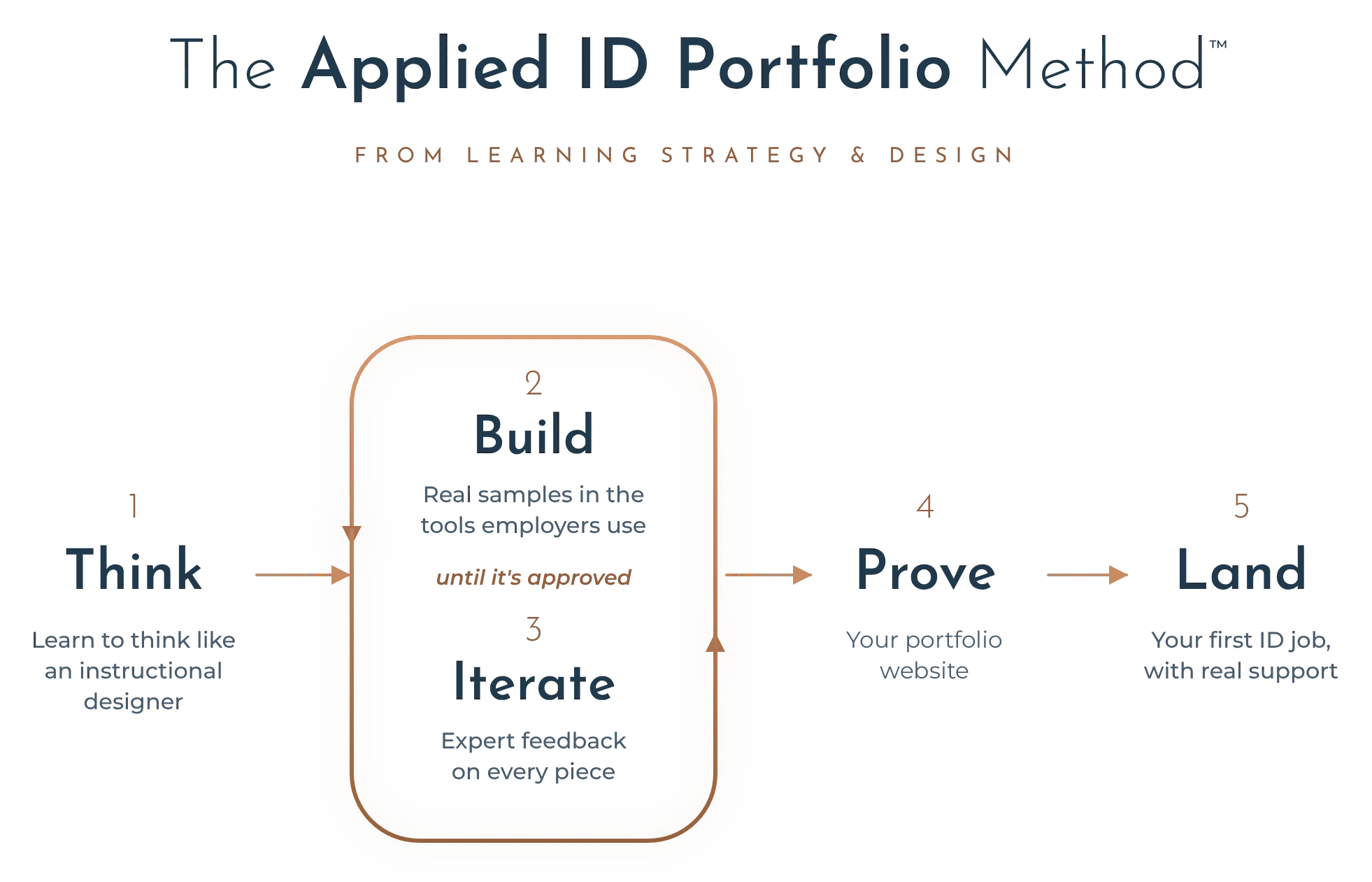
The five stages are Think, Build, Iterate, Prove and Land. You learn the instructional design fundamentals, based on adult learning theory, and the AI fundamentals first, then build your portfolio samples one layer at a time.
Jill Davidian built the Applied ID Portfolio Method from 20+ years of experience with how adults learn: in layers, with feedback and revision until the work is right. In 2019 she created the Applied Instructional Design Academy (AIDA) to teach the practical skills a master’s degree doesn’t, and the method is what AIDA teaches. It answers one question. How does a career changer with no ID experience build a portfolio a hiring manager takes seriously?
The method comes from my 20+ years of experience with how people learn. I have a master's in instructional design, and I've spent my career designing training for adults. Adults learn a new skill in layers. You learn a little, you try it, you get feedback and you fix it. Then you learn more and go again. Every part of the method is built on that loop.
In 2019, I decided to create a program to teach people how to get into instructional design. People had been asking me for years to teach them what I did, a career that let me travel and make good money at the same time. At first, I told them to get a master's degree in the field. Then I realized that wasn't the best way in. Master's degrees are based in theory, and nothing out there offered the chance to learn the practical skills. That led me to create the Applied Instructional Design Academy (AIDA).
Besides teaching practical skills, two things were very important to me from my experience designing learning. I wanted to get someone to an expert level very fast, with a portfolio that showcased their skills so they could compete with job seekers who already had experience in the field. I focused on two ways to get there: scaffolding the content, and building in iteration with multiple levels of feedback.
Scaffolding. When you're trying to become an expert in something quickly, it gets overwhelming fast. Think about trying to learn from YouTube. It's a firehose of information. Scaffolding the learning and giving it a structure, a schema, is what helps your brain absorb it. That's very hard to do outside of a structured program, and I wanted to make sure people had a way to do it.
Feedback. You can only get so far on your own, because you don't know what you don't know. If you could write the perfect essay or the perfect book in your first draft, there would be no need for drafts. The term “rough draft” wouldn't exist. We all need feedback to improve, so somebody else can see something in us that we can't see in ourselves. That's how we get better, how we learn and how we grow, and it needed to be true of this process too.
The method has taken many forms over the years, as I've seen what works and what doesn't with more and more students going through the program. We also survey our students several times a year, and we take their feedback very seriously. In the beginning, we might have had one round of feedback. Then we found that not everyone was putting the feedback in as needed, so over the years we added more rounds and more stages throughout the program. At first, you could move on once we'd given you feedback. That evolved into not moving on until we approved your samples as ready for a hiring manager. That lets us make sure every sample meets a certain standard, both to help you in your job search and because your work reflects on us. A lot of employers come to us asking for IDs.
The goal is samples approved for your portfolio because they've reached a level that doesn't make you look new to the field, a level that replaces experience. This is how you get there.
For many years, we used this method without a name, so the name is the newest part. This is the method AIDA has taught from the beginning, and AIDA now has more than 1,200 graduates.
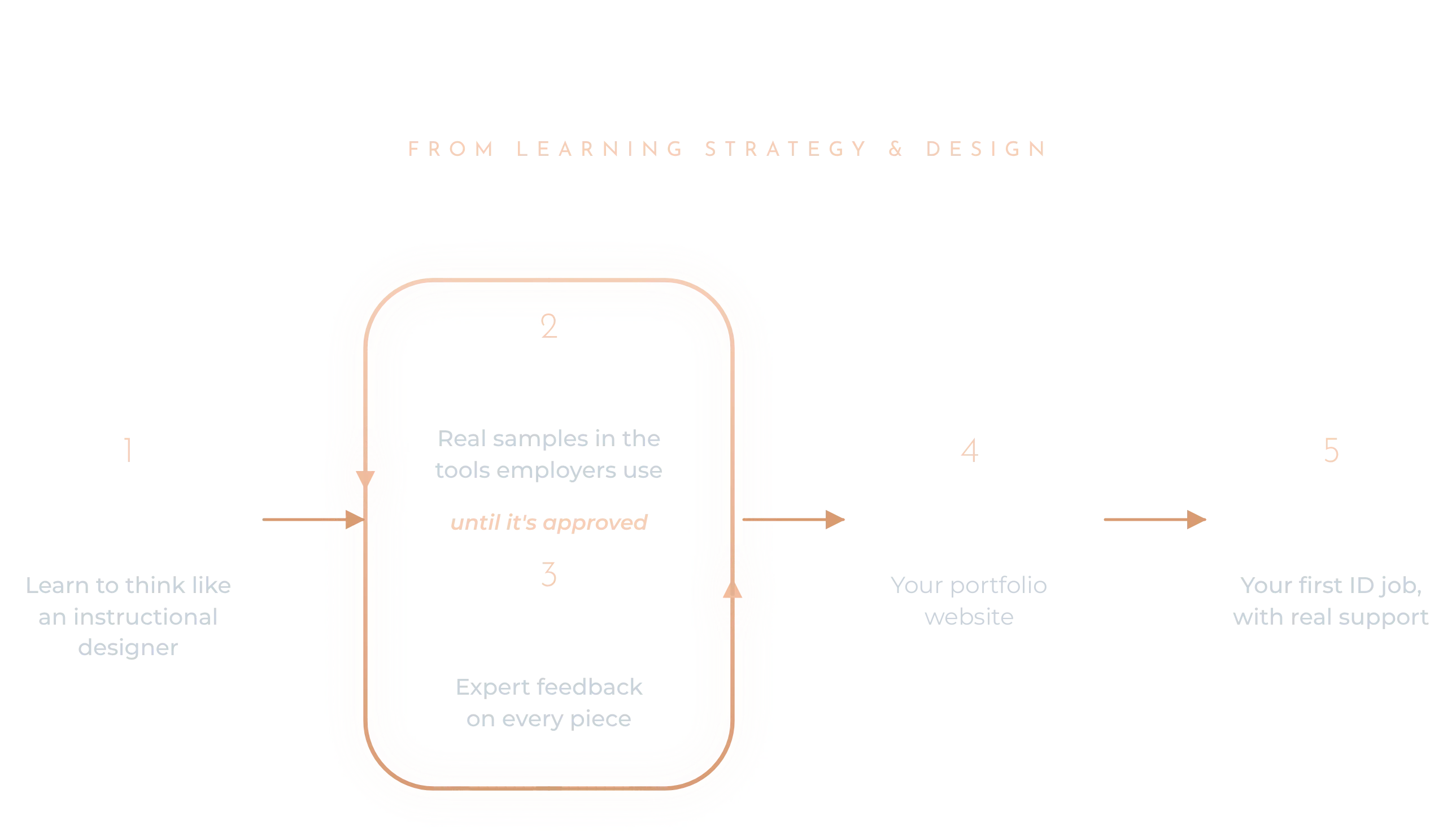
The five stages are Think, Build, Iterate, Prove and Land. Think covers the instructional design fundamentals, based on adult learning theory, and the AI fundamentals. In Build and Iterate you create your portfolio samples and revise each one with expert feedback until it's ready for a hiring manager. Prove turns those samples into a portfolio website, and Land is the job search, with support.
You learn to think like an instructional designer first, and all of it is based on adult learning theory. That's more than writing objectives and assessments. You learn how to create engaging learning for adults that changes behavior on the job and ultimately meets the company's business goals.
You learn how to take a learning project from start to finish, from the kickoff meeting through design, development, delivery and evaluation. You learn how to choose the right delivery method and how to design for each one: eLearning, virtual instructor-led training, instructor-led training and microlearning. And when it's eLearning, you learn to develop it as well as design it, in eLearning authoring tools like Storyline and Rise.
Then come the AI fundamentals: how AI works, and how you work with it on every project using the LEAD AI Framework. You learn the fundamentals of both before you build anything, because you can only evaluate what AI hands you once you know what good instructional design looks like.
You build real course samples in the tools employers use, plus the project documents every working instructional designer produces: a Rise course, a Storyline course built from your own content map, a design document, a storyboard and a job aid. Each one is new corporate work, built for your portfolio from day one.
AI is part of the build. Your Rise sample starts as a draft that Rise's AI builds from your brief. You evaluate it, fix it and add an interaction you build with AI. In Storyline, the AI Assistant helps you build your advanced interaction, and you evaluate every trigger it makes.
This is where the work gets good. You're creating your samples and practicing the work, and every draft gets feedback from expert instructional designers, so you know where to improve. You revise, get feedback again and keep going until the sample is ready for a hiring manager.
Think about how a teacher handles an essay. Students write multiple drafts, and they'd never turn in the rough draft as the final. The rough draft needs feedback to get better. Students don't know what they need to improve, or they'd have done it in the first place, so the teacher's job is to give them that feedback and let them work toward the final draft. Writing a book is the same: you have an editor, and you keep improving it. Your portfolio samples need that too.
In AIDA, we do this through Portfolio-Grade Reviews. Every sample is reviewed against strict rubrics, round after round, and you don't move on until it's approved. If you're doing this on your own, you still need a way to iterate. Find expert instructional designers who will give you feedback on your work, so you know where to improve.
You take your finished samples and turn them into a portfolio website, a clean, professional way to show hiring managers what you can do. Your resume shows your experience up to this point. Your portfolio shows what you can do now: what you've learned to fill in the gaps, and that you can do it for an employer. Case studies show your thinking, a Working with AI page shows how you use AI, and your resume and LinkedIn point to all of it.
This is what replaces experience. An employer doesn't have to guess whether you know how to do something. They can see it for themselves, and all the iteration you did before this step is what makes that possible.
Land is the job search, and it goes better with support. On your own, you can send hundreds of applications and never find out why you aren't hearing back. Career services support gives you someone who knows what hiring managers look for: help translating your resume for corporate roles, networking, mock interviews and feedback while you apply. It's the same idea as Iterate. Someone else can see what's missing and help you fix it.
Full-time jobs and contract work both count, and you can go after either one.
You learn the instructional design fundamentals first, based on adult learning theory, then the AI fundamentals. Then you build your portfolio pieces in a set order: a Rise course built with AI, a Storyline course built from scratch, a design document and storyboard, and a job aid at the end.
The five stages are the method. This is the order I teach it in.
First, the fundamentals of both. You start with Instructional Design Fundamentals, where you learn to design good learning that works, based on adult learning theory. AI for IDs comes right after, so you know how to work with AI before you start building.
Rise now has AI built in, so your first sample is an exercise in evaluating what AI gives you. Rise's AI drafts the course from your brief. You evaluate the draft and fix it until it's good learning, using the LEAD AI Framework.
Next you build from the ground up. First you create a content map, which outlines your course, including your performance-based objectives and assessment questions, so you plan correctly before you start developing. Then you develop your course in Storyline, learning the tool as you go.
On a real project, these come before the build. That saves you time, because you aren't rewriting the course afterward. In the method, you write them after your Storyline course. A storyboard is hard to write before you've ever built anything in Storyline, and yours has to match the course you built.
You finish with a job aid, a quick reference people use while they do the task on the job.
Each piece builds on the one before it. By the end, you've designed and developed a set of samples that shows a hiring manager the range of the job.
Iterate runs through every one of them. Each piece gets expert feedback and rounds of revision until it's ready, before you move to the next. Prove and Land build on those finished samples.
The method is scaffolded, and we call that scaffolding the Skill Ladder. The goal is advanced skills in Storyline, about an 8 out of 10, in a short period of time. You get all of Storyline, advanced features included, one layer at a time, and each time you learn a layer, you go back to the same portfolio draft and make it better.
The goal is to get you to advanced skills in Storyline, about an 8 out of 10, in a short period of time. That's the level that impresses a hiring manager.
Storyline has a higher learning curve, and there are two common ways to teach it. One gives you everything at once, beginner through advanced. If you learned all of it, you'd be advanced, but most people get overwhelmed. The other gives you only the basics so you don't get overwhelmed, and you never learn the advanced skills.
The method does neither. We call it the Skill Ladder. You get all of Storyline, one rung at a time. You learn some, start your portfolio sample and create a draft. Then you learn the next layer and go back to the same draft to make it better. You're iterating on the same sample while you learn more and more, so the sample grows with your skills.
I think of it as collapsing the timeline. It's how you get to an 8 out of 10 with Storyline without the overwhelm.
AI is integrated all the way through. You learn how to work with AI right after the instructional design fundamentals, then use it in your samples, starting with a Rise course built with Rise's AI. How you work with AI follows the LEAD AI Framework, which has its own page.
You learn AI the way you learn everything else in the method, a layer at a time and tied back to the fundamentals. AI drafts. You decide whether what it gave you is good learning, and that judgment is the instructional design skill employers hire for.
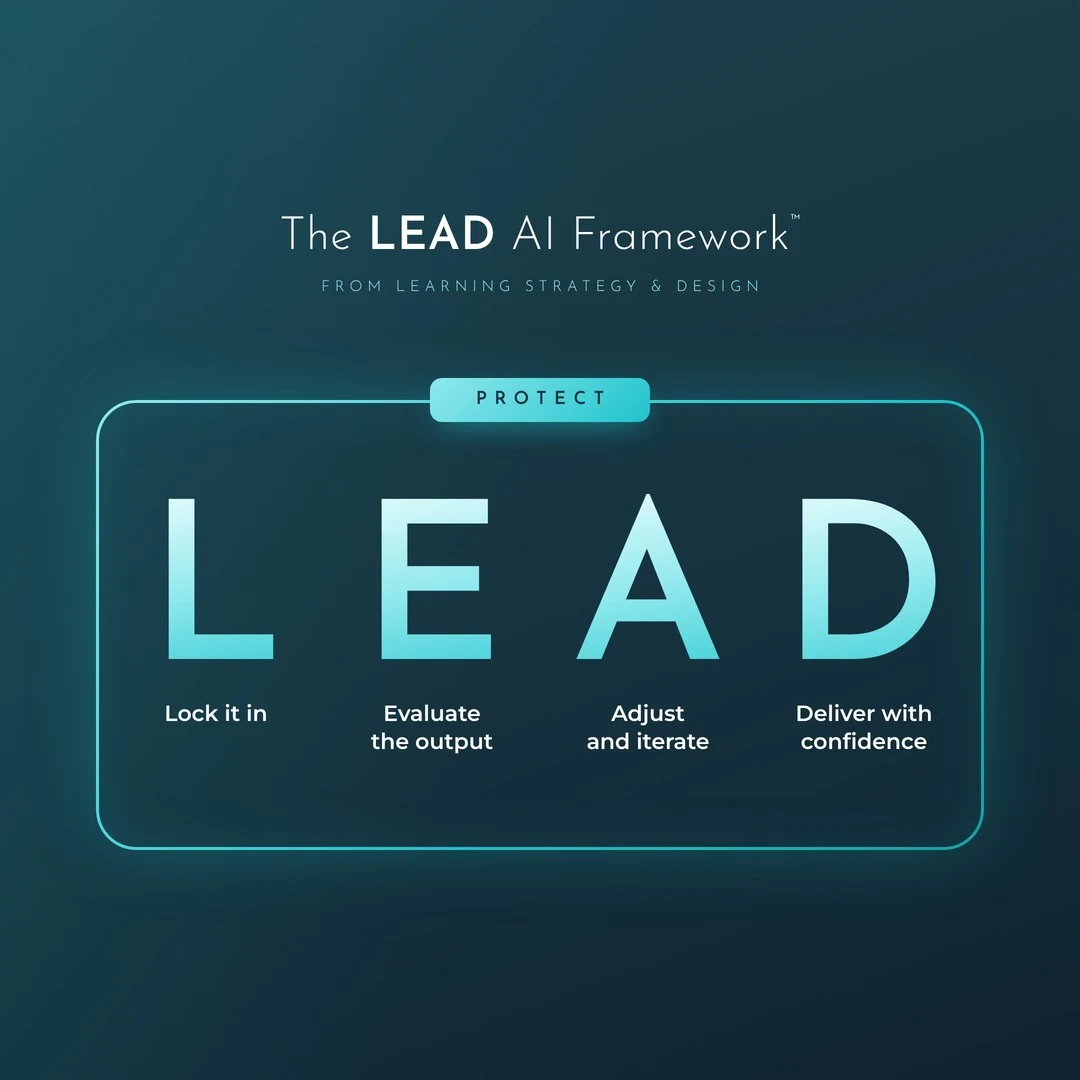
How you work with AI follows the LEAD AI Framework™ for instructional designers, from Learning Strategy & Design. Lock it in, Evaluate the output, Adjust and iterate, and Deliver with confidence, with Protect around all four.
One word shows up in both frameworks. In the Applied ID Portfolio Method, Iterate is expert review by our team, round after round, until your sample is approved. In LEAD AI, Adjust and iterate is your own back-and-forth with AI while you build. Most of your samples go through both.
Before, you're piecing together a path into instructional design on your own, with nobody to tell you what to fix. After, you have the fundamentals of instructional design and AI, advanced skills built a layer at a time, and samples revised with expert feedback into a portfolio that can replace years of experience in a hiring manager's eyes.
You're figuring it out on your own. A master's degree teaches theory and doesn't leave you with a portfolio. Teaching yourself, you get everything at once or only the basics, with a YouTube tutorial open next to a free trial and no way to tell if you're building the right thing. Nobody gives you feedback on your work, so you apply, hear nothing back and don't know what to fix.
You learned the fundamentals of instructional design and AI before you built anything. Your skills went up a layer at a time, to an advanced level in Storyline. Every sample went through rounds of expert feedback until it was ready for a hiring manager. Your portfolio shows the core ID skills and the AI skills employers hire for, and instructional design is your way to freedom, whatever that means to you.
Laura Hall was a high school teacher and program coordinator for 20 years. She spent a year and a half applying on her own, hundreds of applications to instructional design, project management and customer success roles:
I got two interviews over a year and a half, and neither one went any further. I was getting desperate. I didn't know what I was doing wrong.
Nobody was telling her what was missing. She had listed her teaching experience the way she would for a teaching job, and she had gaps in tools like Articulate. What she wanted was a way to “learn the tools, practice with the tools, get feedback on the work.” She found it in AIDA and joined the May 2023 cohort:
Less than a year later, here I am, a happily transitioned teacher and absolutely loving and thriving in my new instructional design role.
And here's what the after can look like, in two stories my students brought back from hiring managers.
One hiring manager had decided she would only hire experienced instructional designers. She'd seen too many career changers change a few words on their resume and apply, and she wasn't going to look at new-to-the-field candidates at all, portfolio or not. Then she saw an AIDA student's portfolio. She hired her anyway, against her own rule.
Another employer loved her AIDA hire but called her an anomaly: “I don't think I'm going to get someone else without field experience who is as good as you.” So they ran a test. The job went up on the regular job sites, and the student brought candidates from AIDA. The manager compared resumes and portfolios side by side and was blown away by the AIDA candidates. She hired one, then two or three more over time. That team now has five or six instructional designers, all from AIDA, and the manager won't hire from anywhere else.
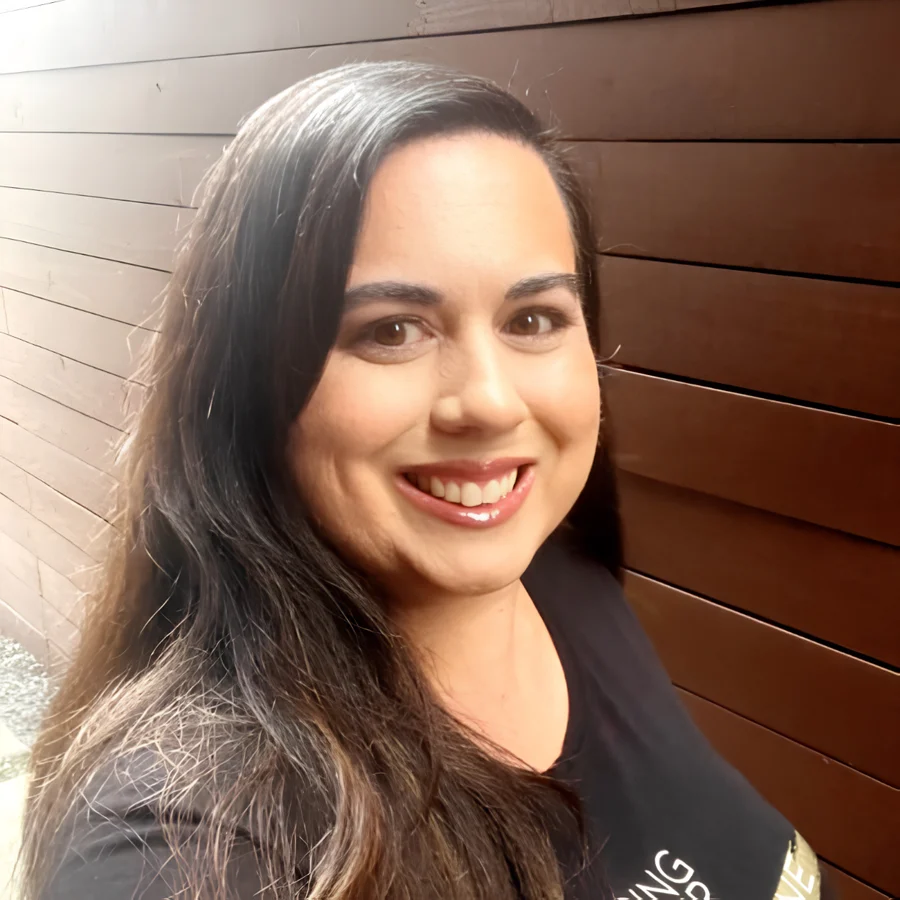
Jill Davidian is the founder of Learning Strategy & Design and creator of the Applied ID Portfolio Method. 20+ years in instructional design, including time as a hiring manager. 1,200+ AIDA graduates. More about Jill
Last updated: November 2026
AIDA, the Applied Instructional Design Academy, is where I teach the Applied ID Portfolio Method, from the fundamentals to the job search. Most people go through it while they're still working, at about 15 hours a week, and mentors review every sample until it's approved, so you always know whether your work is ready. Take a look at the program, and the grad portfolios it produces.
Jumpstart Your Instructional Design Career
A weekly podcast and a Substack on moving into instructional design, from me.