
Free live workshopBecome an AI-Ready Instructional DesignerFree live workshop, Mon Nov 9 to Thu Nov 12, 6:30pm CTSave your free seat →

Is a master's in instructional design enough to get you hired?

For corporate jobs, it's a strong foundation. Your portfolio shows what you can do with it.

Do you need a master's to become an instructional designer?

Quick answer: For corporate ID, no.

Why
Corporate hiring managers look at your portfolio. Most master's programs focus on theory and are geared toward jobs in education, so if you're headed into higher ed instructional design, a master's fits. They aren't geared toward creating training for a company, with all the requirements, processes and tools that come with it. It's just not the way they're set up.
Have one
If you already have one, it isn't wasted. You can pull pieces of it into your work, like design models and how adults learn. When two candidates are otherwise identical, the degree can be the cherry on top. Your portfolio shows the rest.
Grads who came in with a master's
June Gavett
June Gavett
Master's: MS, East Carolina University (2022)
Before AIDA: Applying for ID jobs with her master's
now
Instructional Systems Specialist, U.S. Department of Defense
  • Andi Stanfield

    Andi Stanfield

    Master's: Secondary education and instructional technology

    Before AIDA: Applying for ID jobs with her master's

    Now: Training Officer II, State of Arizona

  • Caroline Hain

    Caroline Hain

    Master’s: Learning and technology

    Before AIDA: Earned her master’s, applied, and still wasn’t getting interviews

    Now: Senior Instructional Designer, Dashe & Thomson

New to instructional design? Start with the Ultimate Guide.

You have the degree, and the interviews aren't coming.

You did what the advice said. You earned the master's or the graduate certificate, maybe while working full time. Then you read real job postings and saw Storyline, Rise and a portfolio link in the requirements. Maybe you've sent out the portfolio from your capstone and heard nothing, or the degree has sat unused while you keep doing the job you wanted to leave.

Most master's programs focus on theory and point you toward higher ed, where the degree is valued. Corporate isn't their focus: how companies create training, the processes they follow, the design documents, the storyboards and the tools. Corporate employers value real work over the degree, and corporate pays a lot better. A really good portfolio beats a master's nine out of ten times.

Jill has one too: an M.S. in Instructional Systems Technology from Indiana University. She's also been the hiring manager reading the portfolios.

Plenty of Applied Instructional Design Academy (AIDA) grads came in with a master's already. Here's how three of them put it.

So I started my master’s program. I worked on that, but then I realized I was not learning the things I needed to learn to be able to start a job the next day. I wasn’t getting that hands on part that I wanted. My master’s was great. I finished the program. I understand theories and project management and all those things, but I went back and found AIDA, and that’s where I got my hands on […] the best practices that people were using in the industry and not just those theories.

Rachel TuhyTeacher with an ID Master’s → eLearning Development Specialist, The Institute for Functional Medicine

As I read through job description after job description, I realized I had amazing book knowledge from my master’s degree. I knew adult learning theory. […] I was ready to do a needs analysis. I was ready to do a storyboard. […] But I realized I was missing things. I realized I didn’t have a portfolio for transitioning into corporate. I didn’t know how to build courses and use Articulate.

Elyse InmanID Master’s → Instructional Designer, SVI World

I was looking for work as an instructional designer for 2 years after receiving my master’s. The portfolio assistance I received here made all the difference. Almost immediately I was getting offers and it wasn’t even complete yet!

Adriel HalliburtonTeacher with an ID Master’s → Instructional Systems Designer, Florida Department of Children and Families

How to take your master's into corporate

1

Find out what a hiring manager looks for

Get your current portfolio, or the coursework you've been sending, in front of someone who's hired IDs. You'll know what's working and what's missing before the next application.

2

Check out examples of corporate ID portfolios from people who have transitioned into the field

Look at the tools they used and how each sample is set up for a business audience, then compare your own work.
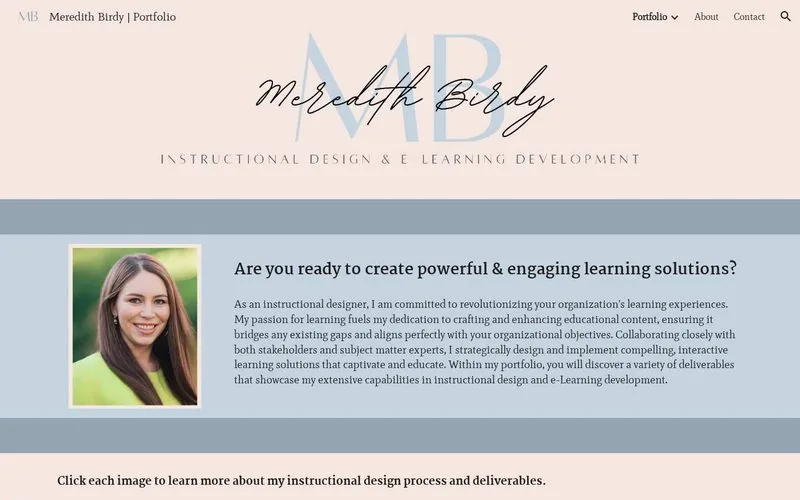
Meredith Birdy’s portfolio home page
Portfolio by Meredith Birdy, a former high school instructional dean turned instructional designer.
3

Build the part the degree skipped

Learn Storyline, Rise and AI step by step, and get every sample reviewed until it's approved. You bring your theory with you. The free workshop, Become an AI-Ready Instructional Designer, Nov 9 to 12, shows you every piece a corporate ID portfolio needs.

Is a master's in instructional design worth it?

Answer one question first: do you want to work in corporate or in higher ed?

If it's higher ed, a master's can make a real difference. You often work with faculty to build university courses, and higher ed values education over practical experience.

If it's corporate, it counts for less, because corporate doesn't value the degree the same way higher ed does. Hiring managers want to see what you can do on the job on day one, and your portfolio is how they check.

Before you pay for any program, ask these questions.

  1. Which authoring tools will I learn, and do they include Storyline and Rise?
  2. Will I leave with corporate-style samples a hiring manager can click through?
  3. Who reviews my work, and do I revise it until it's ready?
  4. How is AI taught, and do I use it on real projects?
  5. What help do I get with the job search, and for how long?

Want more on this? Listen to Should I Get a Master's Degree in Instructional Design? on the podcast.

I looked at doing a master’s, and I just thought, “I don’t know if I have it in me to do a master’s,” because I was working so full time. And now I look back and I’m like, “Thank God I didn’t try to do a master’s,” because I don’t need it.

Carol BeachAccount Executive in Fashion → Lead Instructional Designer, Experian

I did not get a master’s degree in instructional design. I know many people that went into instructional design without a master’s degree. And the thing with a master’s degree is they’re going to teach you information about the theories behind everything. You’re not going to get the hands on skills development like you do through the Applied Instructional Design Academy. They’re not going to have you create a portfolio. You’re not going to learn the different kinds of softwares.

Taylor SakinskyTeacher → Senior Instructional Designer, I-CAR

I had narrowed my search down to 2 Master’s programs, and was planning to enroll even though I wasn’t sure where the tuition money would come from. […] The idea of becoming an ID went from being a “someday goal” to a “I could do this within 9 months!” goal. It changed EVERYTHING for me.

Susan OgilvieTeacher → Sales Enablement Program Manager, Trimble

A master's and AIDA, side by side.

Just to compare a program like AIDA to a master's, here's how the two stack up. It's one route among several.

Master's in ID
AIDA
Best fit for
Master'sHigher ed roles, research, and teaching at a university
AIDACorporate instructional design roles
What you learn
Master'sLearning theory, design models and research
AIDAA step-by-step path through ID fundamentals, the corporate ID process, the authoring tools and AI
Authoring tools
Master'sVaries by program. Many skip Storyline and Rise.
AIDAStoryline and Rise, built up step by step
AI
Master'sVaries by program
AIDAAI fluency with the LEAD AI Framework, plus the AI skills IDs use to build training, on your portfolio projects
Portfolio
Master'sOften coursework, or none
AIDAA portfolio website with corporate-style samples on it: eLearning, a design document, a storyboard and a job aid
Feedback
Master'sUsually a grade per assignment
AIDAEvery piece reviewed by senior instructional designers until it's approved
Job search help
Master'sVaries by school
AIDACareer services built for instructional design: resumes, LinkedIn, interview questions and the application process, tools built to help IDs make the move, calls and support, and connections to employers that hire IDs
Pace
Master'sUsually 30 to 36 credit hours, on the school's calendar
AIDADesigned to be about 6 months, but you can take up to 12, self-paced
Cost
Master'sOften $16,000 to $31,000 for a 30-credit program
AIDA$5,997 in full, or 12 payments of $547
What you walk away with
Master'sA graduate degree
AIDAA certification and a portfolio closely aligned with what employers want to see

Some grads do both. Elyse finished her ID master's first, then came to AIDA for the tools, the samples and the job search. Looking back, she said, “I would save the money on a master's degree and just go with the Academy.”

What people ask us about master's degrees.

Do I need a master's to become an instructional designer?+
For corporate instructional design, no. A master's is the cherry on top. If two candidates are identical in experience, portfolio and skills, the one with the master's probably gets the job. If another candidate has a better portfolio, more experience or better skills for what the company needs, that candidate gets it over the degree. A really good portfolio beats a master's nine out of ten times. A master's carries more weight in higher ed, where universities value the credential and you often work with faculty on their courses.
What can you do with a master's in instructional design?+
In higher ed, it's often the credential universities ask for. In corporate, it gives you the theory side of the job (adult learning, design models, writing objectives), and a portfolio of corporate-style samples is what gets you the interview. Plenty of AIDA grads came in with an ID master's and added the tools, the samples and the job search.
I already have a master's in instructional design. Was it a waste?+
No. It covers real parts of the job: adult learning, design models, writing objectives. What most programs leave out is the authoring tools corporate teams use, corporate-style samples and someone reviewing your work until it's ready. A portfolio shows a hiring manager what the degree can't.
Do I redo what I already learned?+
Very little of it will be a repeat. AIDA is built around what instructional designers actually do in corporate, and most of that isn't covered in a master's program. The one place you may see some overlap is the instructional design fundamentals module, and even that is geared to corporate work, so a lot of it will be new. From what we've seen with master's grads who've gone through AIDA, almost everything else is new. Where you do already know something, it's self-paced, so you can move through that part faster.
Can I use my master's coursework as my portfolio?+
No. Coursework tends to read like school: papers, projects named after classes, and samples built in whatever tool the program used. Build new corporate samples from scratch, for the job you want. What you learned in the program comes with you.
Is it better to get a master's or a certificate?+
Start with where you want to work. For higher ed, a master's can make a real difference. For corporate, start with the portfolio. Some grads do both: Elyse Inman finished an ID master's, then went through AIDA for the tools, the samples and the job search.
Does a master's teach AI for instructional design?+
It depends on the program, so ask to see how AI is taught and whether you use it on real projects. Look for both: AI fluency (knowing when to use it and how to evaluate what it gives you) and the AI skills IDs use to build training. See the LEAD AI Framework.
How long does the switch take?+
According to the AIDA Outcomes Report (623 graduates, 2026), grads go through the program in about 6 months on average and get hired about 4 months after they start applying (554 reported), and most do it while they're still working. Those are averages from our paid work questionnaire, and nobody can promise you a date. They come from a structured program. On your own, without structured feedback from senior instructional designers to speed up your growth and get your samples to hiring manager standards, it can take longer, so use them as a guideline.
I already paid for a degree. How do I know I won't pay again and hit the same wall?+
It's a fair question after what you've already spent. Before you join any program or course, ask three things. Will you build portfolio samples that mimic what you'd do on the job? That's what employers want to see. Are those samples evaluated, and will you get feedback on them? And can you keep getting feedback until they meet hiring manager standards, or is it one round and done? Then look at the finished work. Browse AIDA grad portfolios to see what that looks like.

How much of an instructional designer are you already?

Three minutes, a handful of questions. See which ID skills your degree and your work already gave you, and which you'd still build.

Take the Quiz

Jumpstart Your Instructional Design Career

A weekly podcast and a Substack on moving into instructional design, from me.