
Free live workshopBecome an AI-Ready Instructional DesignerFree live workshop, Mon Nov 9 to Thu Nov 12, 6:30pm CTSave your free seat →

Your next step in L&D is instructional design.

You know how training runs. Now learn to design and build it.

Can a training coordinator, LMS administrator or trainer become an instructional designer?

Quick answer: Yes.

The job
Designing the training companies give their employees. Experts give you the content, and you design how people learn it, usually as eLearning they take on their own.
You bring
You already know how training runs inside a company: the rollout, the tracking, the stakeholders and the business language.
You build
What you build is the design side: the ID process, objectives and assessments, design documents and storyboards, the eLearning authoring tools and working with AI. Your resume shows the first part. A portfolio shows the second.
Where grads work now
Jennifer Schroeder
Jennifer Schroeder
Former career: Technical trainer in biotech
now
Senior Instructional Designer, Penumbra
  • Tamar Fischer

    Tamar Fischer

    Former career: Learning materials for a health tech company

    Now: Curriculum Development & Sr. Instructional Designer, Cox Communications

  • Stephanie Diaz

    Stephanie Diaz

    Former career: Corporate training manager

    Now: Instructional Designer II, AdventHealth

New to all of this? The Ultimate Guide covers the whole path.

Why “I already work in training” isn't getting you interviews.

You've run the trainings, managed the LMS and kept the calendar full. So it makes sense to apply for ID roles with that experience front and center.

If you're a trainer, you deliver instructor-led or virtual instructor-led training. But a lot of the training out there right now is eLearning, and there's no trainer involved at all. The design happens behind the scenes, so it's a related skill set, and a different one.

If you're an LMS administrator, you're adjacent too. You've been in the field and you understand how it all works, which gives you an edge. You still need the skills to design the learning itself.

If your company moved you into an L&D title from another role, you know how training works there. Another company will want to see formal instructional design experience, and a portfolio is how you show it. And if you already design training without the ID title, the next step is running the whole process on your own, start to finish, with samples you're allowed to show.

I will be honest about what happens on the hiring side: running training doesn't read as designing it. A hiring manager opens your portfolio looking for a design document, a storyboard and a Storyline sample they can click through. Without them, you look like a coordinator applying for a designer's job.

The gap is real, and it's a specific list of skills you can learn.

And the design side may be the part you've wanted all along. One trainer told Jill on a call: “I think we should get a better training manual, and I was willing to take that on. And everyone said, ‘I don't see why that's important.’” As an instructional designer, building the better version is the job.

Your resume shows the training you've run. Your portfolio shows the training you can build.

Coming from L&D, you bring the business side of training. The design side is new, and that's where the portfolio comes in.

Tap a skill to see it in your L&D work and in corporate instructional design.

Do you already use AI in your work?
What you bringShows on your resume

Translate what you have (your resume)

Your resume shows the training you’ve run and the business side you know. It’s on you to show how that applies to ID, so rewrite it in instructional design language, in the words ID job postings use, and a hiring manager doesn’t have to make the connection.

What you'll buildShows in your portfolio

Fill in the gaps (your portfolio)

Some of what the job needs isn’t on your resume yet, because you haven’t done it: designing a course end to end and building it in Storyline. So you learn those skills, then build a portfolio that proves you can do them. Start with the free workshop, Become an AI-Ready Instructional Designer, Nov 9 to 12, to see every piece a corporate ID portfolio needs.

To get hired, you need both halves.

Your resume shows what you've already done, translated for corporate ID. Your portfolio proves the skills you've learned since. Hiring managers want to see both.

Already an instructional designer? Start with three questions.

  1. Have you designed or developed eLearning?
  2. If you have, was it in Rise, was it in Storyline, or was it more like microlearning?
  3. Do you have a portfolio?

Your years in the field count. A hiring manager weighs them alongside a current portfolio, and the portfolio is the piece to fix.

No eLearning yet

  • Your work has been instructor-led, virtual instructor-led or microlearning
  • You need to learn how to design and develop eLearning, and build eLearning samples you can show

eLearning in Rise or microlearning

  • You've built in Rise or dabbled in eLearning
  • Storyline is the tool job postings name most, and interviews check it

Storyline at work, no portfolio yet

  • You've built eLearning in Storyline at work
  • It belongs to your employer, so it can't go in your portfolio
  • You've never put a portfolio together, because years ago you didn't need one
  • You need samples you can show

Storyline and samples, never reviewed

  • You already build in Storyline
  • You've built portfolio samples on your own, and nobody has reviewed them
  • You want a hiring manager's read on what works and what to fix
  • The Portfolio Review Session covers it: 45 minutes one on one with Jill, with the recording and a written fix list

If you need eLearning, Storyline itself or samples you can show, you need the whole path.

Want more on this? Listen to The Different Types of Learning Delivery Methods on the podcast.

Kristen Sherman had worked in instructional design before she joined the Applied Instructional Design Academy (AIDA).

"
AIDA gave me the instructional design/eLearning development skills to build on my previous experience to create a portfolio I am proud of and prepared me well for applying and interviewing for instructional design roles.
Kristen ShermanLead Instructional Designer, Schweitzer Engineering LaboratoriesHad worked in instructional design before

How to go from L&D professional to instructional designer in six moves.

1

Get an honest read on your starting point

You know the business side of training and you're starting fresh on design. The quiz shows you how much of an instructional designer you already are, in about three minutes.

2

See how instructional design differs from training

You know training from the delivery side. Instructional design is the design and build side, and more and more of it is eLearning with no trainer at all. Get clear on the difference before you commit.

3

Learn the design process and the tools

You need to learn both: the corporate ID process and the eLearning authoring tools, Storyline and Rise, with AI as part of how you work. Job postings name those two tools most, and interviews may ask about them. Your portfolio shows what you can do in them, so you need real courses built in both, done to a level that reads as expert.

4

Translate what you already have

Rewrite your resume in instructional design language, in the words ID job postings use. It’s on you to show how the training you’ve run and the business you know apply, so a hiring manager doesn’t have to guess.

5

Build the portfolio that shows you can design

Anything you've built at work usually belongs to your employer, so you build new corporate-style samples from scratch that show the design side: a design document, a storyboard, and eLearning built in Storyline and Rise. You’re building for the job you want, not the job you have, and each sample goes through several drafts with feedback on every one, the same way a course gets better with each round of reviewer comments. The free workshop, Become an AI-Ready Instructional Designer, Nov 9 to 12, walks you through every sample a corporate ID portfolio needs.
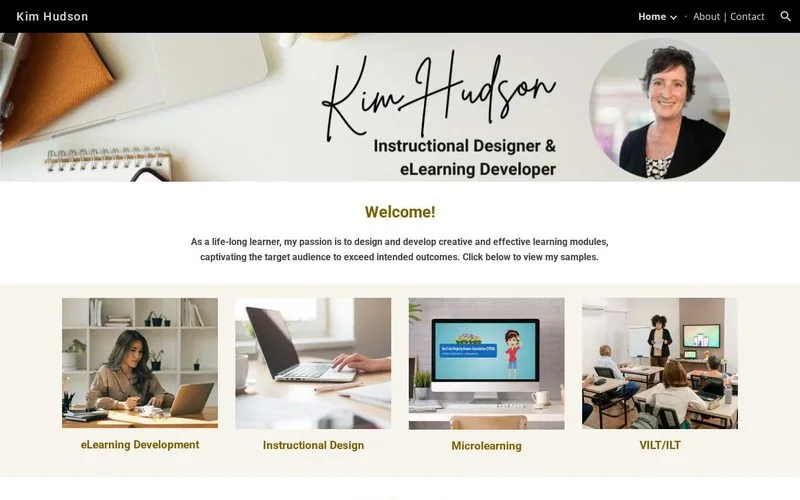
Kimberly Hudson’s portfolio home page
Portfolio by Kimberly Hudson, a former trainer and marketer turned instructional designer.
6

Run your search

Run a focused search. Your L&D network knows the people who hire IDs, and most people underuse it.

L&D grads who made the move.

"
I can now say I had actually 10 years of instructional design experience. I just didn’t know how to speak to that. But I didn’t have the technology piece.
Gina Hauth MillerGina Hauth MillerCorporate Trainer → Instructional Designer and Developer, TrainingPros

"
I knew what I was doing was creating the training, but I didn’t realize there was an actual name for that. I was always just known as the trainer, so I didn’t realize there was such [a] thing as instructional designing and developing. So I was all self-taught.
Jody GayeskiJody GayeskiTechnical Trainer → Instructional Designer, various contracts

  • June Gavett

    June Gavett

    Former career: Training specialist

    Now: Instructional Systems Specialist, U.S. Department of Defense

  • Dean Wilkerson

    Dean Wilkerson

    Former career: Corporate trainer (Verizon, then mortgage)

    Now: Technology Learning & Adoption Training Specialist (contract), Cooley LLP

  • Michelle Cranmer

    Michelle Cranmer

    Former career: L&D and organizational development

    Now: Instructional Designer, various contracts

  • Jesse Dowden

    Jesse Dowden

    Former career: Corporate trainer, mostly virtual training

    Now: Instructional Designer, American Medical Technologists

What grads report.

Here's what Applied Instructional Design Academy (AIDA) grads report, sample sizes included.

$76K
Average starting grad salary · 312 reported
61%
Of surveyed grads work fully remote
$42/hr
Average contract rate · 206 reported
497+
Companies have hired our grads

Some grads are earning $10K to $15K more five years later. Results vary.

Run your own numbers

What would the switch pay in your state?

Entry-level ID salary in your state $81,959
$55,000
$30k$150k
The difference, per year
+$26,959
That's $2,246 a month, before you negotiate.
Market estimates for entry-level instructional design roles by state.

What L&D folks ask us most.

I already work in training. Do I really need a program?+
Some people don't. What you need is the portfolio: a design document, a storyboard, and Storyline and Rise samples that show you can take a project from the first conversation with a subject matter expert to a finished course. If you can build it on your own, and you have expert instructional designers that can give you feedback, and you can iterate to make sure that your samples are really solid, then go ahead and do it on your own.
What's the difference between a corporate trainer and an instructional designer?+
As a trainer, you deliver the learning. An instructional designer designs and builds it: analyzes the business problem, defines objectives, structures the content, writes the storyboard and builds the course. And a lot of the time, nobody delivers it at all. Trainer positions are becoming few and far between as companies move more of their training online. eLearning people take on their own, with no instructor, is now much more common than instructor-led or virtual instructor-led training, so a trainer position is much harder to find. A big part of the job is making training engaging on a screen. Sometimes you design training for trainers to deliver, but most of the time you don't. It's a much more behind-the-scenes job.

If you like being in front of a room, that still counts. Some companies run in-person trainings, and that's a skill you'd bring with you. They just want the design skills too. The move is learning that process and proving it in a portfolio.
Does my LMS experience count for anything?+
Yes. You know how learning gets deployed, tracked and reported, which many new IDs don't. Many instructional design jobs are actually combined with LMS administration, so it can be a real plus. Pair it with real authoring-tool samples and it sets you apart.
Will ID pay more than my current role?+
It depends on your market and where you're starting. AIDA grads report a $76K average starting salary (312 reported) and a $42 an hour average contract rate (206 reported).
Will my employer pay for instructional design training?+
It's worth asking. A lot of companies have money set aside for training, and some would rather pay to train you formally, since you already know the business, than hire an instructional designer from outside. AIDA has an employer kit for the conversation with your manager: a one-page business case, the full syllabus, every module outline and a request letter you can fill in. Get the employer kit.
Isn't the field saturated?+
The front door is crowded with people who have nothing to show yet. A strong portfolio and a network get you through it, and 497+ employers have hired AIDA grads.
Will AI replace instructional designers?+
AI amplifies how a company already worked. Companies that value good learning use AI to automate and speed up the parts of the job that aren't instructional design, like tech support for the tools, so their instructional designers can do the design work well. Companies that never cared about training were building it without IDs long before AI, and IDs still had jobs. What employers want now is IDs with AI fluency.

Find out how much of an ID you already are.

Three minutes, a handful of questions, and you'll see which skills you already bring and which ones you'd build.

Take the Quiz

Jumpstart Your Instructional Design Career

A weekly podcast and a Substack on moving into instructional design, from me.