
Your corporate experience is a head start. Here's how to add the training side.
Can you become an instructional designer without a teaching background?
Quick answer: Yes.

Carol Beach
Former career: Account executive in fashion
Now: Lead Instructional Designer, Experian

Michelle Stanley
Former career: Virtual health coach (dietetics and nutrition)
Now: Instructional Designer, Sun Auto Tire & Service

Dustin Tran
Former career: Civil engineering drafter
Now: FTRC Instructional Technologist, Dallas Fort Worth International Airport
Want the full picture first? Start with the Ultimate Guide.
Teachers are loud in ID spaces because a lot of them are making this exact move. No job posting requires a teaching license. Hiring managers require a portfolio, and they honestly don't care whether the person behind it spent the last decade in a classroom or in claims processing.
Coming from marketing, HR, healthcare, finance, sales, ops or any other field, you skip a step the teachers have to work through. Your resume already speaks corporate. You've sat in business meetings, worked against quarterly goals and survived reorgs. What you're missing is the learning science, the tools and the proof, and all three are buildable.
Maybe the next step up looks like more of what you already don't want. One logistics manager told Jill the next step on his path was VP, and he didn't want to spend his next 20 years on it. Instructional design is a way to keep your business sense and change the work you do with it.
Maybe you run the new-hire class on top of your real job, wrote the manual nobody asked for, or became the trainer because you were the best at the work. Maybe you're the expert who teaches a few classes a week in your field. Nobody called it instructional design, and nothing you built can leave the building.
A hiring manager still wants to see the process behind the work: the analysis, the objectives, the design document and the storyboard, then a course built in the tools. When the job put you in front of the room first, nobody taught you that part. So you learn the process and the tools, and you build samples you can show, set in a field you already know. Your industry knowledge makes them stronger.
Instructional design keeps you working with people, too: subject matter experts, stakeholders, and sometimes the learners in the room.
Coming from another corporate field, you bring the business side of the job and maybe some informal training. The design side is new, and that's where the portfolio comes in.
Your resume shows the informal training you’ve done and that you know the business side. It’s on you to show how that applies to ID, so rewrite it in instructional design language and a hiring manager doesn’t have to make the connection.
Some of what the job needs isn’t on your resume yet, because you haven’t done it. You can’t list ten courses built in Storyline. So you learn those skills, then build a portfolio that proves you can do them. Start with the free workshop, Become an AI-Ready Instructional Designer, Nov 9 to 12, to see every piece a corporate ID portfolio needs.
To get hired, you need both halves.
Your resume shows what you've already done, translated for corporate ID. Your portfolio proves the skills you've learned since. Hiring managers want to see both.
In this order. The most expensive mistake is buying a credential before building proof.
Before you commit evenings and money to this, get a real answer. The quiz shows you how much of an instructional designer you already are, whatever field you're coming from.
Corporate ID, higher-ed ID, and ed-tech ID are different jobs with different pay and different doors in. Most career changers want corporate without knowing why. Know why before you build.
The corporate ID process, objectives and assessments, then the eLearning authoring tools, Storyline and Rise, with AI as part of how you work. Scaffolded, in order, without the firehose. You need to learn both the process and the tools: job postings name those two tools most, interviews may ask about them, and your portfolio shows what you can do in them.
Your resume already shows the business side and any training you've done informally. Rewrite it in instructional design language so a hiring manager can see how your experience applies. It's on you to make that connection for them.
Whatever you've made at work belongs to your employer, so your portfolio starts with new corporate-style samples, built from scratch for the job you want, not the job you have. Take each one through several drafts with feedback on every one, the same way a report or proposal gets better with each round of edits. Bonus move for you: build samples set in your old industry, and you become the ID who already knows the business.
Start with the free workshop, Become an AI-Ready Instructional Designer, Nov 9 to 12, so you know what you're building toward.
Here's your other unfair advantage: you already know people inside companies that buy training. Former colleagues become referrals. Pair that with real openings.
Accounting, mortgage lending, civil engineering, publishing, behavioral health and more. Here's where some of them work now.
 Yuliya SharshatkinaCPA → Lead ID & Pod Lead, Intuit
 Kimberly HudsonTraining, Video Editing and Marketing → Senior Instructional Designer, Raymond James

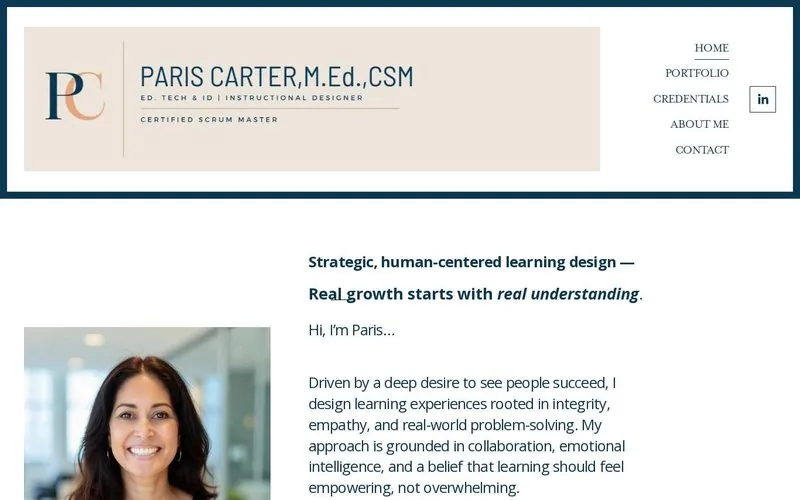
Paris Carter
Former career: Mortgage loan originator and insurance quality reviewer
Now: Instructional Designer, Career Certified

Marissa Gingold
Former career: New accounts manager at a wholesaler
Now: Instructional Designer, Optimum/Altice USA

Keitaro Matsuoka
Former career: Freelance textbook copyeditor
Now: Learning Experience Designer, ACAMS

Kate Compton
Former career: Technical writer
Now: Instructional Designer, Capstone ITS

Steven Cohara
Former career: Residential specialist in behavioral health
Now: Learning and Development Specialist, Gills Point S Tire & Auto Service

Deenah Darom
Former career: Graphic design and technical writing
Now: Instructional Designer III, ISACA

Rachel Srinath
Former career: Executive assistant, PwC
Now: Instructional Designer, Career Certified

Kellie Bassett
Former career: Office manager
Now: Instructional Systems Specialist III, Millennium Corporation

Jessica Thomas
Former career: Project manager, Comerica Bank
Now: Instructional Designer, various contracts

Agnes Szoltysek
Former career: Retail manager and online ESL tutor
Now: Instructional Designer, various contracts

Jamila Thompson
Former career: Non-technical project manager, Fannie Mae
Now: Lead, Learning Strategy & Enablement, Fannie Mae

Celeste Ramsey
Former career: Regional IT support specialist, RTI International
Now: Instructional Designer, various contracts
Here's what Applied Instructional Design Academy (AIDA) grads report, sample sizes included.
Some grads are earning $10K to $15K more five years later. Results vary.

Jill Davidian is the founder of Learning Strategy & Design and creator of the Applied ID Portfolio Method. 20+ years in instructional design across oil and gas, healthcare, hospitality, finance, and more. 1,200+ AIDA graduates. More about Jill
Last updated: November 2026
Three minutes, a handful of questions, and you'll see your skills the way a hiring manager would, whatever field you're coming from.
Take the QuizJumpstart Your Instructional Design Career
A weekly podcast and a Substack on moving into instructional design, from me.