

What the job postings ask for, the new work AI is creating, and what to learn first.
AI amplifies how a company already was. In 60 instructional design job postings I reviewed in spring 2026, 8 mentioned AI in any form, and the rest asked for the same core skills as always: the design process, subject matter experts, design documents and storyboards, Storyline and Rise. AI makes parts of the job faster. It needs an instructional designer to brief it and evaluate it.
Here's what I've seen after 20+ years in this field. The work AI replaces is rote and mechanical, tasks that don't take higher-level thinking. Instructional design is about understanding how people learn, getting a subject matter expert's knowledge into something a learner can use, and designing for a change in what people do.
AI can help with pieces of that. Feed it a good brief and you get a usable draft. Feed it nothing and you get generic training you can spot from a mile away. Somebody still decides what to feed it and whether what comes back is any good, and that somebody is you.
For the bigger picture of how AI fits into each step of the job, AI in instructional design walks through it.
The same companies that built training without instructional designers before AI. AI amplifies how a company already was.
Many people think AI is going to replace jobs. One conference I attended was actually called AI Fails. L&D professionals and managers were there to discuss how AI has failed them and the lessons they learned, and every session was about how the human stays in the loop and leads the process.
If AI taking jobs is a fear of yours, I want to tell you a little bit about how this industry has worked for many years. There are two types of companies:
I know you've seen this, because we've all taken training at our jobs, and we've all taken training that was awful. Even in my own career, when I say that I design training for companies, many people say, “Oh, you're that person, the one who designs all that awful training I have to take every year.” That's because a lot of training is designed by the companies that don't care.
In the age of AI, all AI is doing is amplifying how a company already was. Companies that care about learning, like the ones at that conference, want AI to automate and accelerate the parts of the job that don't involve instructional design, so instructional designers can really do their jobs well. It's actually amplifying instructional designers and mitigating a lot of the things we had to do before that had nothing to do with instructional design, like tech support for the tools we use.
Companies that didn't care about training to begin with are now using AI to do more with less and to build training faster with people who are not IDs. They already did that before. Nothing has changed. If IDs still had jobs when companies were creating garbage training before, IDs will still have jobs going forward when companies are creating garbage training.
All that to say, there are companies who want you to know how to use AI to work more efficiently so you can be a better ID, and that's where AI fluency comes in.
Mostly the core skills. In 60 postings from spring 2026, 8 mentioned AI, usually as help with writing or storyboarding.
I wanted to know what employers were asking for, so I pulled 60 instructional design job postings from across the country this spring and read them.
Eight of the 60 mentioned AI in any form. The other 52 asked for what I've always taught: the instructional design process from start to finish, running a kickoff meeting, working with subject matter experts, writing design documents and storyboards, and building in Storyline and Rise. When a posting did mention AI, it was usually light, help with writing or storyboarding.
For an outside read on the field, the Bureau of Labor Statistics covers this work in its Occupational Outlook Handbook under training and development specialists.
Because of the highlight reel. Social media shows you the companies moving fastest on AI, usually the biggest ones with the budget to move quickly. You don't see the much larger number of small and mid-sized companies, where a lot of people get their first ID job, that are still slow to adopt new technology. Plenty of them are still catching up on eLearning.
I've watched this pattern before with Storyline and Rise. Instructional designers who kept learning the new tools stayed in demand, and the ones who stopped learning fell behind. Standing still is what gets you passed over.
I see it with our graduates too. Some of them walk into their first ID job worried the team will find out how new they are, and then learn they were hired to bring in Storyline, Rise or eLearning itself.
Yes. Every new AI tool a company rolls out needs training, and instructional designers build that training.
Yes, and this part gets less attention. Every change needs training. AI is a lot of change, so companies need training on how to use it, how to brief it well and how to fit it into the way their teams already work. One of our Applied Instructional Design Academy (AIDA) mentors, a senior instructional designer, is building an AI curriculum for her own company right now.
AI is also creating new roles, like the AI architect positions now showing up in postings: someone who works out how AI can make a company run more efficiently, tailored to how it actually works. The only thing constant in life is change, and change is what keeps instructional designers busy. We're in the middle of a lot of it, which makes this a good time to come into the field.
Yes. Learn the instructional design fundamentals first, then AI right after, and use both on your portfolio samples.
Yes, in the right order. Learn the instructional design fundamentals first: adult learning, objectives, assessments and how a corporate project runs. Learn AI right after, before you build your portfolio, so every sample shows both. You can only evaluate what AI gives you once you know what good instructional design looks like.
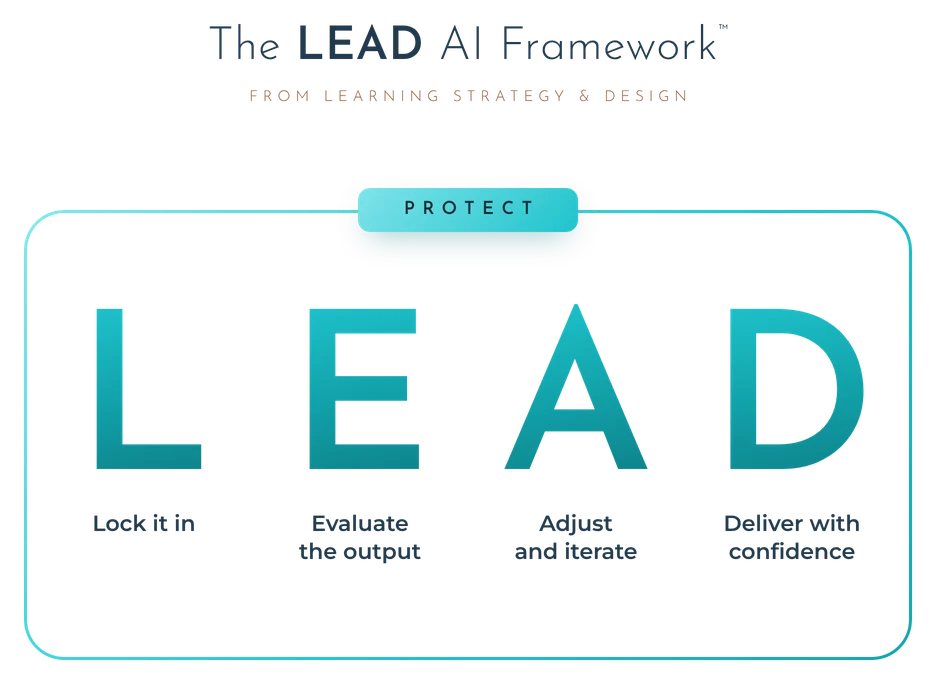
The way I teach working with AI is the LEAD AI Framework: lock in the brief, evaluate the output, adjust and iterate, and deliver with confidence, with protecting private and company information around every step. In interviews, be ready to describe a real AI workflow and a time AI was wrong and you caught it.
More on AI in instructional design

Written by Jill Davidian, founder of Learning Strategy & Design and creator of the Applied ID Portfolio Method. 20+ years in instructional design, including time as a hiring manager. 1,200+ AIDA graduates. More about Jill
Last updated: November 2026
Where AI shows up in each step of the instructional design process, what it can't do, and how to learn it.
Read AI in Instructional DesignJumpstart Your Instructional Design Career
A weekly podcast and a Substack on moving into instructional design, from me.